
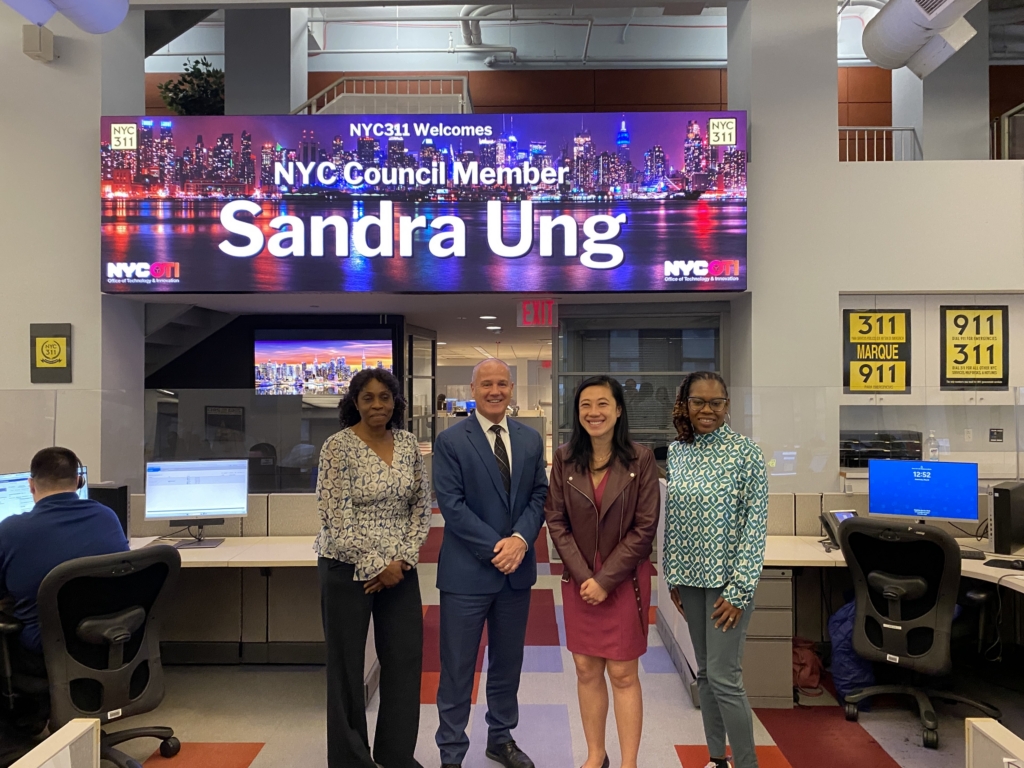
The City Council unanimously passed two bills introduced by Council Member Sandra Ung at its Stated Meeting on Thursday that will improve the experience for callers to the 311 Customer Service Line who have limited English proficiency.
“Roughly 25 percent of New Yorkers are considered to have limited English proficiency, and they deserve the same access to government services and information as their English-speaking neighbors,” said Council Member Sandra Ung. “Unfortunately, when they call 311 they encounter obstacles and delays accessing the information and resources they need. These two bills will create protocols to ease their connection to an interpreter, while releasing data on wait times will provide a level of transparency that will help us understand their experiences when calling 311. I want to thank Speaker Adams for her leadership and bringing these bills to the City Council floor for a vote.”
Callers to 311 who need an interpreter often have to request translation services from an English-speaking call taker, who may have trouble identifying the caller’s language. This can result in the caller being connected to an interpreter who does not speak the correct language.
Intro 296 requires the development of a protocol to identify the languages spoken by callers to 311. It also requires that certain calls that require interpretation services be reviewed to determine if the protocol should be amended or updated.
In other cases, the caller does not realize they are waiting for an interpreter and simply hangs up before being connected to someone who can help them.
Intro 206 requires the Department of Information Technology and Telecommunications to compile and release data on the length of wait times for callers to 311 who request translation services to better understand their experiences with the service center.
“There are over 200 languages spoken in New York City, and I appreciate the difficulty of managing a call center like 311 in city this diverse,” said Council Member Ung. “But callers with limited English proficiency should not receive a lesser quality of service when it comes to accessing government services, resources and information.”