
- The OneLIC Task Force
- OneLIC Neighborhood Plan Passes
- Join the OneLIC Oversight Committee
- OneLIC Investments
- What is OneLIC?
- Our Priorities for the OneLIC Project
- Frequently Asked Questions
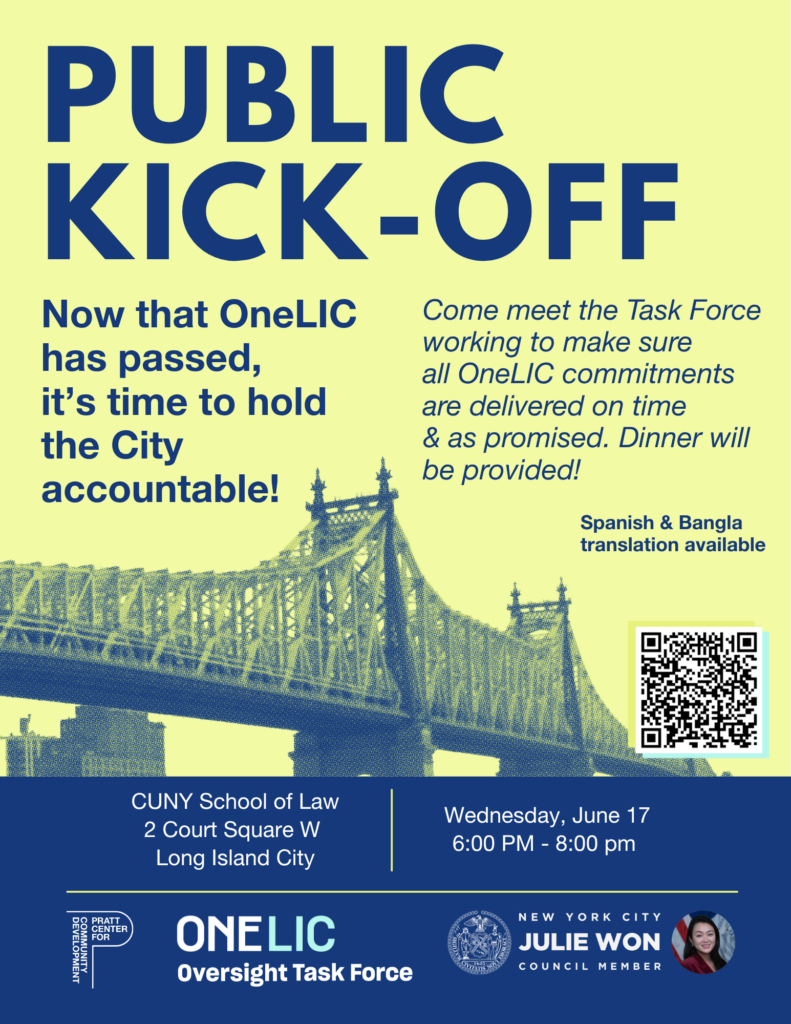
Join the First Meeting for the OneLIC Taskforce!
The OneLIC Oversight Task Force is a volunteer, community-based group tracking the City’s progress on commitments made in the OneLIC Neighborhood Plan.
The Task Force holds public meetings three times a year and invites City agencies to report on the status of the City’s commitments. The Task Force is facilitated by Pratt Center for Community Development.
Council Member Won Secures Historic Wins for Long Island City with Passage of the OneLIC Neighborhood Plan
Council Member Won Delivers Nearly $2 Billion in Investments, Affordable Housing, and Infrastructure for Long Island City After Years of Developer-Led Failures.
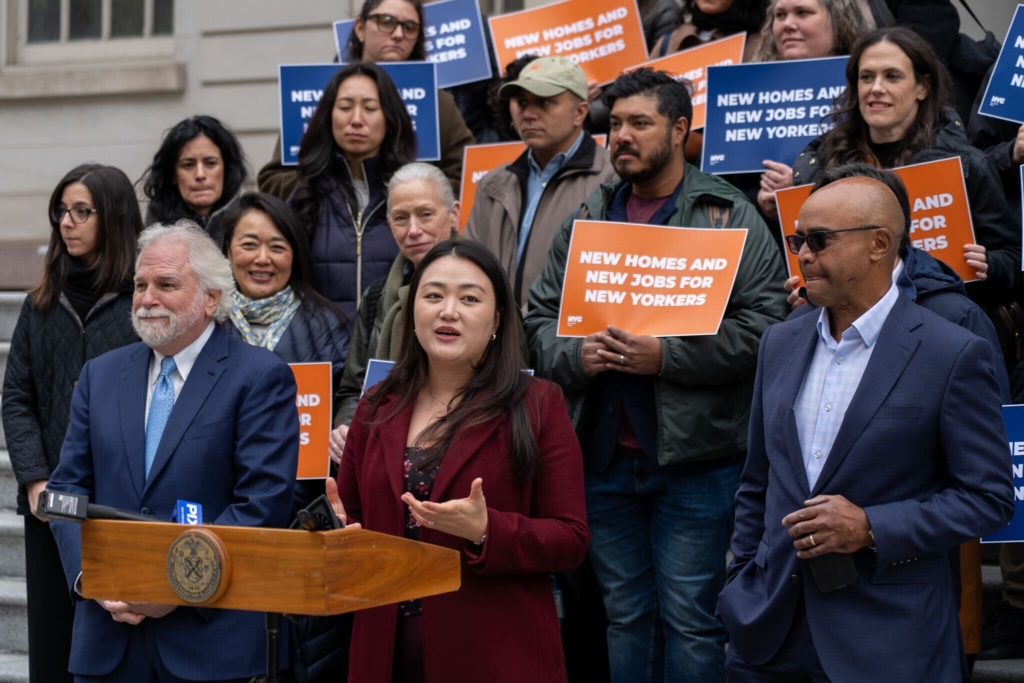
November 12, 2025 – After months of negotiations with the Mayoral administration, Council Member Julie Won and the City Council unanimously voted to approve the OneLIC Neighborhood Plan. Four previous rezonings—Anable Basin Special District, LIC Innovation Center, Amazon HQ2, and YourLIC—all failed because of a lack of investment in community needs. Instead of providing a $3 billion handout to Amazon, this vote secures a historic investment of nearly $1.97 billion in City investments addressing key priorities identified through more than two years of extensive community engagement. OneLIC, which will rezone 54 blocks in Long Island City, represents the largest increase of affordable housing units ever produced by a rezoning, creating 14,700 new housing units, including approximately 4,350 affordable units in Long Island City.
Through persistent and focused attention to the priorities of her constituents, Council Member Won secured crucial infrastructure improvements, addressing neighborhood needs, including the following highlights:
- Extensively mapping Mandatory Inclusionary Housing (MIH) in Long Island City for the first time, requiring a minimum of 20-25% permanently affordable units on all private sites.
- Making only the most deeply affordable MIH options available to developers:
- Option 1, on average, serves households earning no more than 60% of AMI. This is equivalent to $68,040 for a household of one and $87,480 for a household of three.
- Option 3, on average, serves households earning no more than 40% of the Area Median Income (AMI). This is equivalent to $45,360 for a household of one and $58,320 for a household of three.
- Maximizing deeply affordable housing on public land, creating nearly 1,000 units of affordable housing, with at least 50% for Extremely and Very Low-Income families.
- Restoring Queensbridge Baby Park, creating over 5 acres of new open space under the Queensboro Bridge, making this the largest expansion of parkland through a rezoning in the last decade.
- Guaranteeing 1,300 additional new school seats to address current needs and accompany future growth in Long Island City, including two new elementary schools, a new middle school, and a new home for BSGE.
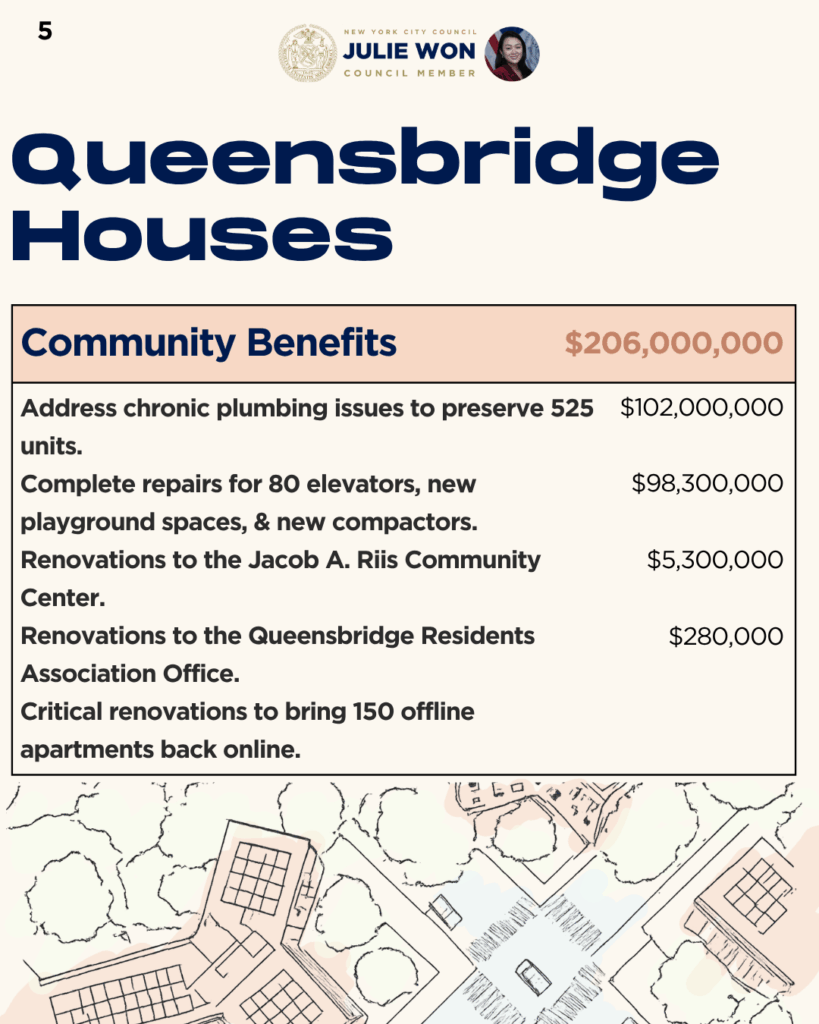
- A $206M investment in Queensbridge Houses to upgrade community facilities and preserve approximately 675 units of public housing, addressing chronic plumbing issues and bringing vacant units back online.
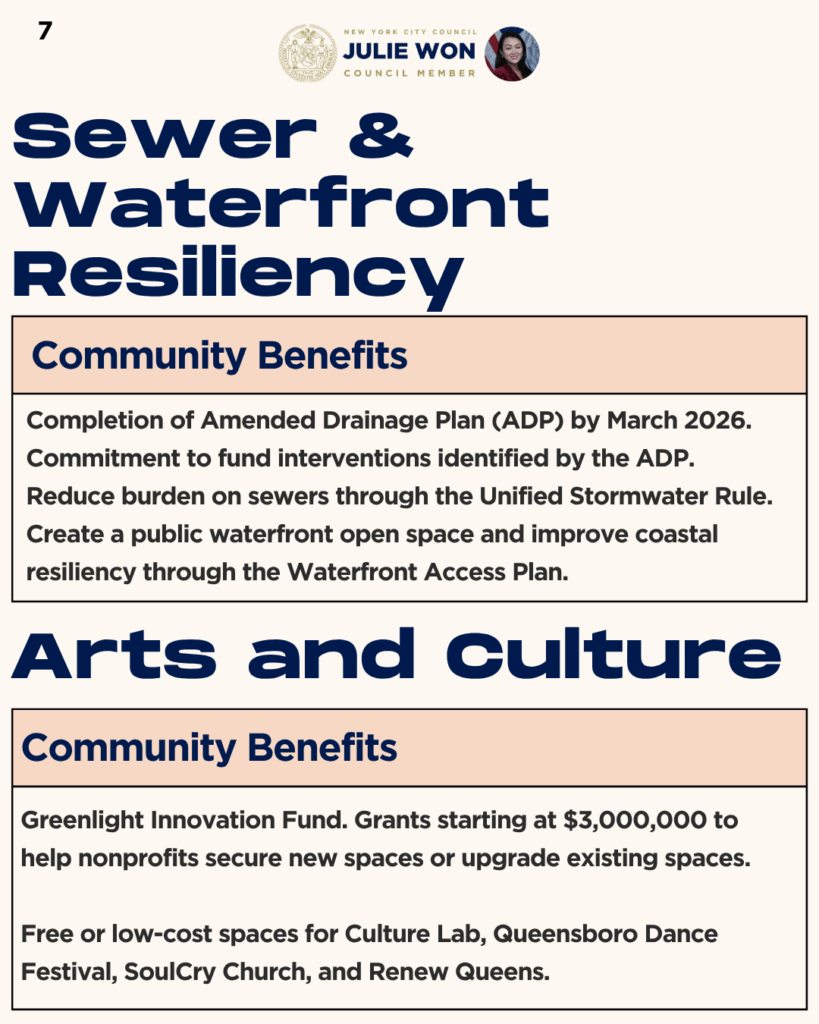
- Securing investments in critical sewer and stormwater management infrastructure to address existing flooding and improve neighborhood resilience.
- Establishing a Waterfront Access Plan and creating a publicly accessible waterfront connecting Gantry Park to Queensbridge Park.
The City and ConEd are in the process of negotiating the transfer of an easement for the waterfront portion of ConEd’s property. Next steps to facilitate the easement and complete design and construction are outlined in the timeline below:
- By December 2025, City’s appraisal of ConEd property will be completed.
- By Mid-December 2025: ConEd expected to submit a petition to the Public Service Commission.
- By June 2026: The City will select a design consultant.
- By June 2028: Design, permitting, and bidding begins.
- By 2033: Construction completion.
In addition to City investments in OneLIC, private developers in the rezoning area have also committed to providing the following community benefits:
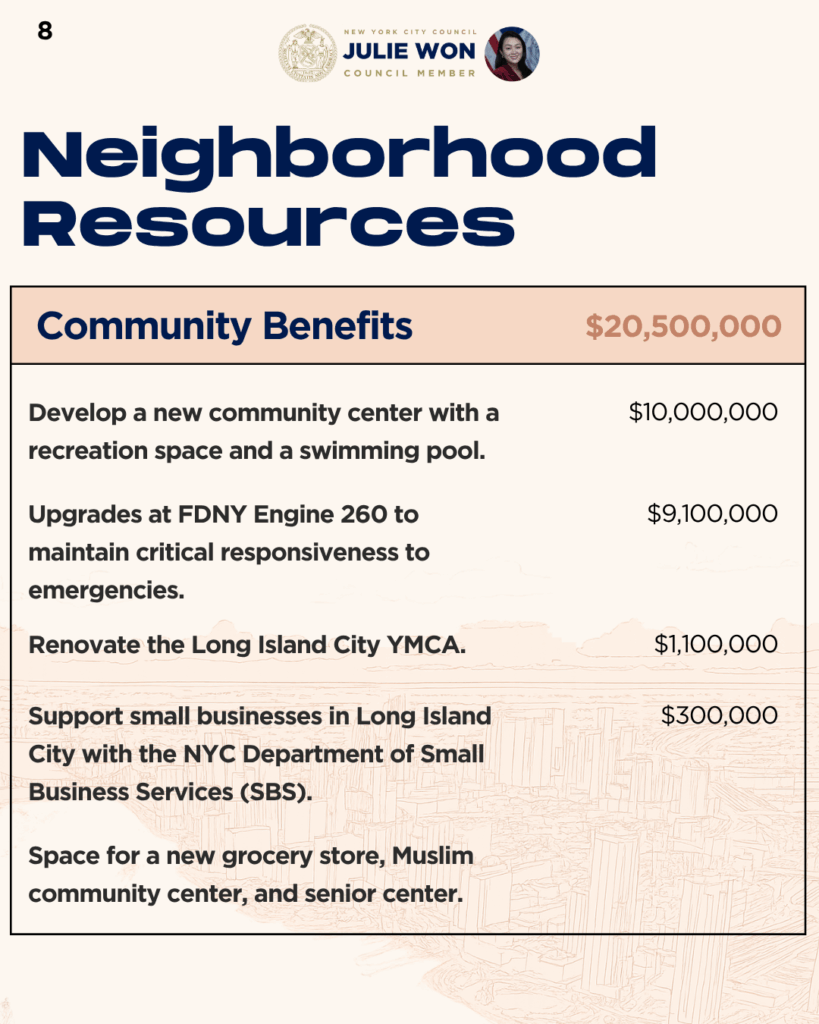
- A new community center that includes a swimming pool and active recreation spaces
- Working with the School Construction Authority to build new schools
- Space for new early childhood education centers and a senior center
- Free or low-cost space for arts and culture nonprofits and local faith-based organizations, including the development of a new Islamic community center
- Space for a new affordable grocery store
Throughout the two year public engagement process, Council Member Won shaped a community driven proposal that addressed the needs of Long Island City residents after numerous discussions with community members, Queens Community Boards 1, 2, and local elected officials. Over the past two years, the Department of City Planning in partnership with Council Member Won organized:
- 21 large-scale public events that included town halls, Focus Area Meetings, and walking tours. These events were attended by over 1,800 attendees and received over 5,750 comments.
- The Department of City Planning and Council Member Won’s office also released two surveys asking community members to share what they envisioned for the city-owned sites. All together, 2,350 people responded to these surveys.
- A mailer sponsored by the City Council to over 14,000 households in the OneLIC Study Area including Queensbridge with a link to a digital survey.
- Over the course of several months, canvassers knocked on over 8,000 doors at Queensbridge Houses.
- Information about OneLIC was provided at dozens of community events including Family Day and Resident Association meetings by the Office of Council Member Won and the Department of City Planning.
- 213 comments were received, including nearly 100 from Queensbridge residents at the Department of City Planning’s Scoping Hearing for the Draft Environmental Impact Statement.
- At two Community Board 1 and 2 hearings, over 350 written comments were received and approximately 200 people testified. Roughly 75% of public testimony was supportive, 15% mixed or conditional, and only 10% opposed.
- Hundreds of individuals also testified and shared comments with the Office of the Queensborough President, City Planning Commission, City Council, and other public meetings.
We acknowledge the work is not done, these commitments are only words on paper unless we hold the City accountable. We will be working with our neighbors to establish a Community Oversight Committee, which will track the implementation of these commitments and make sure everything that was promised gets done.



What is OneLIC?
The Long Island City Neighborhood Plan (“OneLIC”) is a comprehensive planning process that develops the vision and goals of the community through extensive direct engagement.
The Long Island City Neighborhood Study (“the Study”) is led by the New York City Department of City Planning (DCP), with funding from City Hall. The study area extends from the East River and Gantry Plaza State Park at the southwest, north to Queens Plaza and the Long Island City Industrial Business Zone, and east to Court Square and 23rd Street.
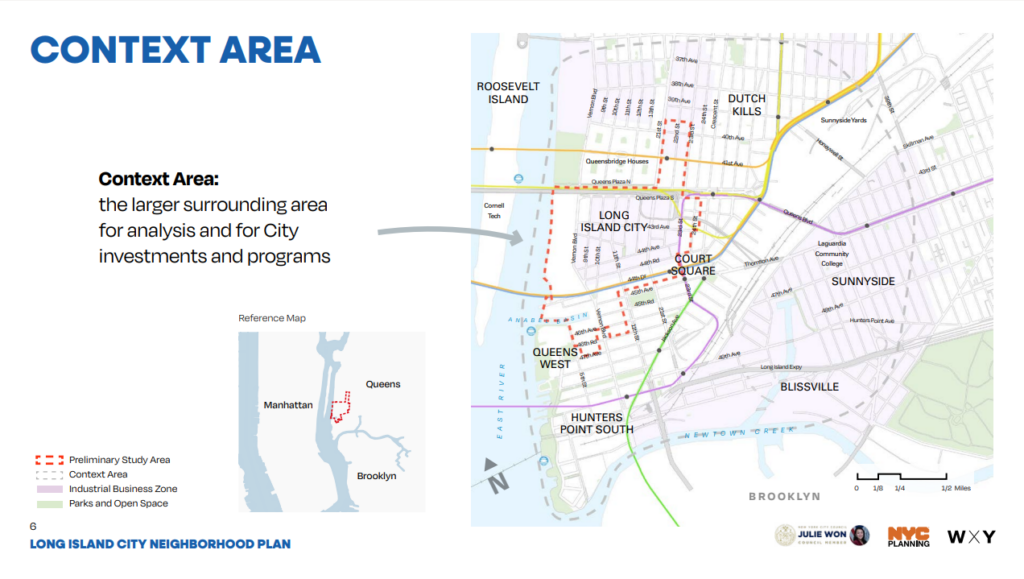
This planning process aims to unite these disparate areas to create one holistic Long Island City neighborhood. The Study will examine ways to create new housing, economic growth, transit connectivity, and open space, concluding with a neighborhood plan that includes land use zoning changes to guide new development in the neighborhood, as well as proposals for capital investments, programs, and services.
Our Priorities for the OneLIC Project
These priorities are the minimum requirements for the OneLIC neighborhood plan to succeed and receive Council Member Won’s support when it comes before the City Council for a vote.
- Affordable Housing: Maximize development of permanently affordable housing units at a range of income levels with a focus on family-sized units, achieved through a combination of permanently affordable housing on public sites and inclusionary housing (MIH) on private sites.
- A Connected Waterfront: Development of a connected waterfront esplanade from Queensbridge Park to Gantry State Park across both public and private sites. To allow for this, Con Edison and the New York Power Authority must commit to agreements to provide at least 40 feet of waterfront space for development of public open space as part of the contiguous waterfront on their sites.
- New Public Spaces: Creation of new public open spaces on the City-owned sites under the Queensboro Bridge and its ramps currently used by the NYC Department of Transportation (DOT) and NYC Parks Department (Parks) for operations, parking, and storage. Redevelopment of these sites into public open space would return public land back across from Queensbridge to the community and connect Queensbridge with the rest of Long Island City, and address the dire need for increased open space in the neighborhood. To allow for the redevelopment of these sites, DOT and Parks must commit to relocating their operations elsewhere.
- Investment in Sewage, Plumbing, and Resilience Infrastructure: City commitment to providing new funding for capital investments in sewage and plumbing infrastructure in LIC to address current flooding and sewer issues, and prepare LIC’s infrastructure to support new development in the neighborhood and increase resilience along the waterfront.
- New Schools: To address the critical need for new school seats within the district, on-time siting and development of new schools; in addition to the on-time construction and opening of schools already sited in LIC, including the Court Square K-8 school and Hunters Point South Parcel C K-8 school.
- Queensbridge Houses Investments: Investments in capital upgrades at Queensbridge Houses, the Jacob Riis Settlement House, and the prioritization of the rehabilitation of nearly 150 dilapidated, vacant apartment units to make them habitable.
- Community-Driven Development of Public Land: City commitment to prioritizing a range of uses on public land to meet community needs, including developing affordable housing and home ownership options, and following a community-driven process for transforming the City-owned 44-36 Vernon Blvd Department of Education (DOE) site. As part of this process, the City will release a Request for Information (RFI) this spring to gather input on potential uses for the DOE site (such as land trusts and community facilities) and ensure the final Request for Proposals (RFP) released for the site is shaped by community feedback.
Frequently Asked Questions
How is OneLIC different from the 2001 rezoning in LIC?
Since the last public rezoning of Long Island City in 2001, the neighborhood has seen rapid development and population growth. Unfortunately, sewer and plumbing infrastructure, school construction, and open space per capita have lagged in relation to this development boom. Furthermore, rents have increased, with vacancy rates hitting a historic low, especially among family-sized units. Twenty-four years later, we now have better policy tools in our hands, and a once-in-a-generation opportunity to make Long Island City a more livable, equitable neighborhood with enough school seats, more affordable housing options, more family-sized housing units, more open space, a connected waterfront, and improved infrastructure. These critical investments that come with city-led rezonings will not be holistically implemented if we rely on individual developer-led private rezonings.
- Mandatory Inclusionary Housing (MIH) did not exist in 2001. As a result, none of the new private development spawned by the 2001 rezoning were required to include affordable units. Today, there is almost no MIH housing in LIC. Enacted in 2016, MIH requires all developers who benefit from a change in zoning to set aside 20-30% of new residential projects for income-restricted units. While the MIH options made available can require average AMIs (Area Median Income) of 40%, 60%, 80%, and 115%, Council Member Won has committed to ensuring that the 115% AMI option is NOT available to developers in the OneLIC rezoning, and instead, only the 40%, 60%, and 80% AMI options.
- The Unified Stormwater Rule (USWR) did not exist in 2001. Passed in 2022, the USWR created new stormwater management requirements for all new development and redevelopment sites that discharge to NYC sewers. Development sites measuring more than 20,000 square feet—the majority of sites within the rezoning area—are now subject to strict requirements such as porous pavement, water infiltration chambers, and green roofs that will result in effective stormwater management and prevent flooding.
- The 2001 rezoning did not include updates to the Northern Hunters Point Waterfront Access Plan, which was established in 1997 and is now outdated. OneLIC includes an updated Waterfront Access Plan that would require all waterfront sites to provide public access to the waterfront and meet higher citywide standards for resilient waterfront design if sites are redeveloped. Additionally, OneLIC will provide opportunities for owners of waterfront sites to develop their sites in accordance with newer national certification programs for resilient waterfront design, such as the Waterfront Edge Design Guidelines (WEDG) Certification, ensuring that the LIC waterfront is developed to the highest standards for waterfront design possible and the neighborhood is well prepared to withstand future climate events.
- While Council Member Won welcomes the benefits brought about by these new tools, she continues to push the City for more community investments and benefits that are essential to the success of this neighborhood plan.
A main focus of the OneLIC Neighborhood Plan is new housing development. What type of housing will be created in LIC?
- The Draft Environmental Impact Statement (DEIS) for OneLIC estimates the creation of approximately 14,699 new housing units, including approximately 4,300 permanently income-restricted housing units.
- For affordable housing development on private (MIH) and public sites, Council Member Won is prioritizing permanently affordable housing for a range of incomes, with a focus on households considered “low-income” (up to 40%, 60%, and 80% of AMI).
- Council Member Won is prioritizing the creation of family-sized units so that families are able to stay in LIC long-term.
How affordable will the new housing created by OneLIC be?
- Since 2022, the City has only subsidized rental units up to 120% of AMI and not above. In compliance with this policy, no subsidized rental housing units built through this rezoning will have AMIs above 120% of AMI. Furthermore, Council Member Won is committed to prioritizing lower AMIs (40% AMI, 60% AMI, and 80% AMI) on private sites (through MIH) as well as public sites.
What is Mandatory Inclusionary Housing (MIH)?
Enacted in 2016, MIH requires all developers who benefit from a change in zoning to set aside 20-30% of new residential projects for income-restricted units.
MIH Options 1-3:
| Option 1 | Option 2 | Option 3 | |
| % of Floor Area Required to Set Aside for Income-Restricted Units | 25% | 30% | 20% |
| Avg. AMI of Affordable Units | 60% AMI | 80% AMI | 40% AMI |
| Max. Salary | HH of 1: $68,040 / HH of 3: $87,480 | HH of 1: $90,720HH of 3: $116,640 | HH of 1: $35,360HH of 3: $58,320 |
| Max. Rent for Avg. AMI | Studio: $1,6302 BR: $2,097 | Studio: $2,1742 BR: $2,796 | Studio: $1,0872 BR: $1,398 |
Council Member Won has committed to ensuring that the 115% AMI option (Option 4) is not available to developers in the OneLIC rezoning, and instead, only Options 1, 2, and 3.
What is a Waterfront Access Plan?
- New York City’s waterfront zoning regulations require new, privately-owned developments to include public waterfront spaces that complement the City’s network of public parks. A Waterfront Access Plan (WAP) adapts standard waterfront zoning regulations for specific site conditions. It is generally developed through a comprehensive planning process that involves the surrounding neighborhood.
- The OneLIC waterfront falls within the Northern Hunters Point Waterfront Access Plan, which was established in 1997 and is now outdated. The existing WAP does not include current waterfront public access requirements to enhance the design and resiliency of waterfront spaces. OneLIC would update the Hunters Point North WAP to require that all waterfront sites contribute to a publicly accessible waterfront that is held to a higher standard of design.
Why isn’t Queensbridge included in the Neighborhood Study Area?
- The OneLIC rezoning study area only includes parcels of land that will have their zoning designations changed or will be affected by the updated Waterfront Access Plan. Queensbridge is not included in the study area because the City is not proposing updated zoning on the Queensbridge campus, and it is not on the waterfront.
- However, Queensbridge is within the larger context area for the project, which means Queensbridge and its residents will benefit from broader neighborhood investments the City will make as part of the neighborhood plan. These could include specific capital investments into Queensbridge Houses, in addition to City investments into services and infrastructure that will benefit residents of the LIC neighborhood more broadly, such as investments in parks and open spaces, new schools, and other new or upgraded community facilities in the neighborhood.
- The Council Member views public rezonings as an opportunity to secure investments from the City to meet capital needs within the district. Therefore, the capital needs of Queensbridge Houses and its residents will be taken under consideration as part of the negotiations with the City for a broad package of capital commitments that will be part of the final OneLIC Neighborhood Plan.
How have Queensbridge Houses residents been engaged throughout the OneLIC planning process?
- The project was launched at Queensbridge Park with the Resident Association
- Over 3,000 units, all apartments in Queensbridge, received a mailer with a survey asking residents to share their priorities for the project.
- Canvassers spent multiple days on the ground knocking on 4,973 doors, some of them multiple times, asking residents to complete a survey, gathering info on community priorities for the OneLIC Plan. Gift cards were offered.
- 253 Queensbridge residents completed the OneLIC community priorities survey conducted by Council Member Won’s office in 2024-2025. This population represents 17% of total survey responses and 24% of total responses from residents of key LIC neighborhoods. Comparatively, Queensbridge residents represent approximately 14% of the total LIC population.
- Outreach was done at Queensbridge Family Day and other community events at Queensbridge Houses.
- A virtual “Focus Area Meeting” was held for Queensbridge residents with flyers posted in every building and outreach conducted throughout the development.
- An in-person Focus Area Meeting event was held at Jacob Riis Settlement House.
- Council Member Won’s Office and the Department of City Planning presented at Resident Association meetings multiple times.
- As a result of thoughtful engagement with the Resident Association, Jacob Riis, community leaders, and canvassing by Council Member Won’s Office, about 100 Queensbridge residents submitted testimony for the Draft EIS public hearing in July 2024.
What about capital needs for Queensbridge?
- Since the start of the neighborhood planning process, Council Member Won has heard from constituents about the need for capital funding for improvements at Queensbridge Houses.
- Throughout the ongoing OneLIC ULURP process, Council Member Won is prioritizing the City’s commitments to improvements at Queensbridge Houses, including investments in maintenance, capital upgrades, and rehabilitation of the nearly 150 dilapidated, vacant apartment units to make them habitable.
- A final list of capital commitments from the City will be agreed upon before the City Council vote at the end of the ULURP process. Council Member Won has made it clear that she will not greenlight the project without adequate investments from the City to meet community needs.
How can Queens Community Boards 1 & 2 vote yes on the OneLIC Neighborhood Plan without clear capital commitments from the City?
- Capital improvement funding gets negotiated for all neighborhood rezonings between project certification and the final City Council vote held at the end of the ULURP process. Council Member Won is actively engaged in negotiations with City Hall, DCP, and other key city agencies to shape a robust list.
- A final list of capital commitments from the City will be agreed upon before the City Council vote at the end of the ULURP process. Council Member Won has made it clear that she will not greenlight the project without adequate investments from the City to meet community needs.
- The City is required by law to publish a list of capital and programmatic commitments made by the Administration with neighborhood-scale rezonings. These commitments are typically detailed in the Points of Agreement negotiated between the local Council Member and the City is required to issue an annual progress report detailing the status of each initiative. Please review the City maintained online commitment tracker to view the types of capital and other non-zoning commitments made of neighborhood zoning similar to OneLIC: NYC Rezoning Commitments Tracker.